Socializing a Blue Heeler With Kids, Dogs and Strangers
General training information. Every dog is an individual; for health or behavior concerns, see your veterinarian.
Blue Heeler socialization is not about making a dog friendly with everyone. It is about teaching a smart, watchful herding dog that ordinary life is safe, so it can stay calm around children, other dogs and visitors.
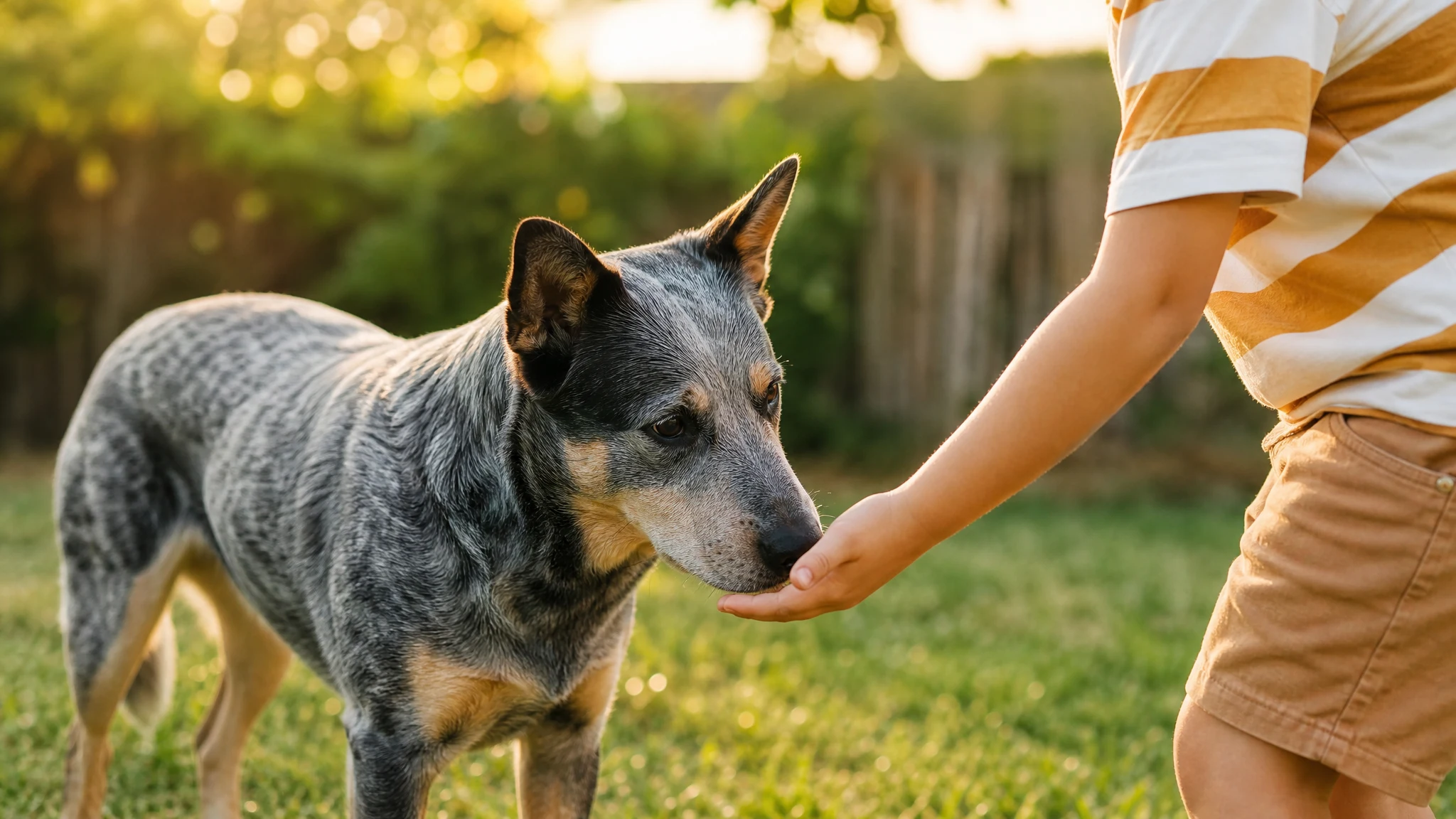
The Australian Cattle Dog Club of America (ACDCA) describes the breed as highly intelligent, self-directed, loyal and protective, with a strong desire to please. The breed standard also notes a natural suspicion of strangers. That mix is lovable, but it means socialization is a job you plan, not something that just happens.
What the breed sources say first
If you are asking whether Blue Heelers are good with kids, the honest answer is "it depends on the dog and the plan." The Westminster Kennel Club breed page, which is not the AKC, rates the breed 3 out of 5 for good with children and 3 out of 5 for good with other dogs. That is a middle score, not a promise in either direction.
The UK charity PDSA adds a specific warning. The herding instinct may lead to heel nipping at running children. The breed was developed in Australia to work cattle on harsh, unfenced range, according to the ACDCA, so chasing and nipping at moving heels is part of the original job.
Individual dogs vary. Treat these ratings as a reason to prepare, not as a verdict on your dog.
Materials you need
- A flat collar or harness and a standard 6-foot leash.
- Small, soft treats your dog loves, cut into pea-sized pieces.
- A clicker or a consistent marker word such as "yes." The ACDCA says the breed excels at clicker training.
- A baby gate, exercise pen or crate for breaks and supervised separation.
- Chew toys and a food puzzle for calm downtime.
- A notebook to log what your dog met and how it reacted.
- A positive puppy class. The ACDCA recommends them.
Step-by-step socialization plan
Step 1: Start with a calm base
Before you add people or dogs, teach your dog to look at you for a treat when you say its name. Practice "sit," "go to your mat" and a relaxed leash walk at home. These give you something to ask for when the world gets exciting.
For a deeper foundation, see our complete guide to Blue Heeler training.
Step 2: Use the early weeks well
The ACDCA advises keeping puppies with the litter until at least 7 to 8 weeks and socializing early. During that time the puppy learns bite inhibition from littermates and mom. Ask your veterinarian which outings and places are safe for your puppy's vaccination stage.
Early socialization means short, pleasant exposures. Let your puppy watch things from a distance, then pay it with a treat for staying relaxed.
Step 3: Introduce strangers on your dog's terms
Because the breed standard notes a natural suspicion of strangers, never push a dog to be petted. Follow these rules:
- Ask the visitor to ignore the dog at first. No staring, reaching or high-pitched greetings.
- Let your dog approach if it wants to. If it hangs back, that is fine.
- Have the visitor toss a treat toward the dog, not hand it over face to face.
- Click and treat your dog for calm behavior, such as sitting or looking at you.
- End the session while your dog is still comfortable.
Repeat with many different people over time: different ages, hats, jackets, beards, umbrellas and uniforms. Variety teaches the dog that unfamiliar does not mean threat.
Step 4: Build safe habits around children
This is the step where most Blue Heeler owners need to be most careful. Because PDSA flags heel nipping at running children, plan around it.
- Supervise every interaction. An adult should be within arm's reach and paying full attention. Use a gate or crate when you cannot watch.
- Teach kids the rules. No chasing the dog, no hugging or climbing on it, no grabbing the tail, and no bothering it while it eats or rests.
- Start with calm kids. Have a child sit on the floor and toss treats while the dog stays on leash. Quiet and still is easier for a herding dog than running and shrieking.
- Practice movement slowly. Have a child walk, then jog a few steps, while you reward the dog for staying with you. Increase only if your dog stays relaxed.
- Redirect nipping early. If the dog lunges toward feet, calmly step away, ask for a sit or send it to its mat, and reward the right choice. Offer a toy it can carry or tug in a separate play session.
The ACDCA says puppies must learn not to nip inappropriately and should be taught bite inhibition. Start this early and keep it consistent. If nipping gets worse or you see stiffening, growling or snapping, contact a qualified, reward-based trainer for hands-on help. For anything that might be pain or a medical issue, ask your veterinarian.
Step 5: Introduce other dogs gradually
For a Blue Heeler with other dogs, the Westminster rating of 3 out of 5 suggests it is worth working at, not leaving to chance. Go slowly.
- Begin at a distance. Walk at a spot where your dog can see another dog but stay calm. Reward it for looking at the dog and then back at you.
- Move to parallel walks. Two handlers walk side by side with space between the dogs. Close the gap only if both dogs look loose and relaxed.
- Keep greetings short. Allow a few seconds of sniffing on a loose leash, then call your dog away and reward it.
- Choose calm, friendly dogs. Pick known, well-mannered dogs for early practice. Avoid crowded dog parks while your dog is still learning.
- Watch for herding play. Chasing, circling and nipping at another dog's heels can be a herding habit. Interrupt it, give a break and reward calm play.
Step 6: Add exercise and a job
The Westminster Kennel Club rates the breed's energy level at 5 out of 5. The ACDCA says these dogs need a job or purpose plus both physical and mental exercise, and PDSA says over 2 hours of exercise a day. A bored, under-exercised dog is more likely to practice unwanted habits, including nipping and fixating on movement.
Puppies should avoid extremes of exercise until their joints mature, according to the ACDCA. Ask your veterinarian what is right for your puppy's age.
Sports can give a Blue Heeler a healthy outlet. The ACDCA Versatility Award covers obedience, rally and agility, and AKC herding tests and trials exist for the breed's original skills.
Step 7: Keep it up for life
Socialization is not finished at puppy class. Keep adding new people, places and dogs, and keep rewarding calm behavior. Review your notes every few weeks and slow down if your dog seems stressed.
Tips that help
- Use short sessions of a few minutes. End on a success.
- Reward what you want to see, such as sitting, looking at you and staying loose. The ACDCA says positive training works best and that harsh physical methods are seen as a challenge by this breed.
- Give the dog distance from whatever worries it. Distance is the easiest tool you have.
- Teach the dog a place to settle. A mat or crate gives it a safe spot when visitors arrive.
- Plan ahead for guests. Put the dog behind a gate with a chew until it is calm, then introduce it on a leash.
- Pay attention to body language, such as a stiff body, hard stare, tucked tail or lip licking, and back off when you see it.
Common mistakes to avoid
- Flooding the dog. Crowded events too early can teach a watchful dog that the world is stressful.
- Forcing greetings. Making a suspicious dog accept petting from strangers can backfire.
- Leaving kids and the dog alone together. Even a calm dog needs an adult watching.
- Letting nipping slide. A small puppy nip becomes a bigger problem if it works to start the chase game.
- Skipping exercise. A dog with too much unused energy is harder to socialize.
- Using harsh corrections. The American Veterinary Society of Animal Behavior (AVSAB) supports humane, reward-based training. Avoid shock, prong or choke collars, scruffing, alpha rolls and any dominance-based methods.
- Leaving the dog unattended in the yard. PDSA notes the breed dislikes it, and a bored dog can pick up bad habits.
What results to expect
With steady, reward-based practice, many Blue Heelers may become calmer and more predictable around visitors, children and other dogs. You may notice your dog checking in with you more and recovering faster after something startling.
Progress varies with the dog's age, background and temperament, and with how consistent the household is. Some dogs may stay reserved with strangers, which fits the breed standard's note about suspicion. A reserved, polite dog can be a good outcome.
Herding urges may never disappear completely. The goal is manageable behavior through supervision, training and appropriate outlets. If you are worried about aggression or fear, ask your veterinarian to rule out medical causes and then work with a qualified reward-based trainer.
Quick checklist
- Calm basics practiced at home first.
- Short, positive exposures to many kinds of people.
- Constant adult supervision around children, with clear rules for kids.
- Slow, controlled introductions to other dogs.
- Daily physical and mental exercise.
- Notes kept and plan adjusted as your dog grows.