Leash Training a Blue Heeler: Pulling, Lunging and Loose-Leash Walking
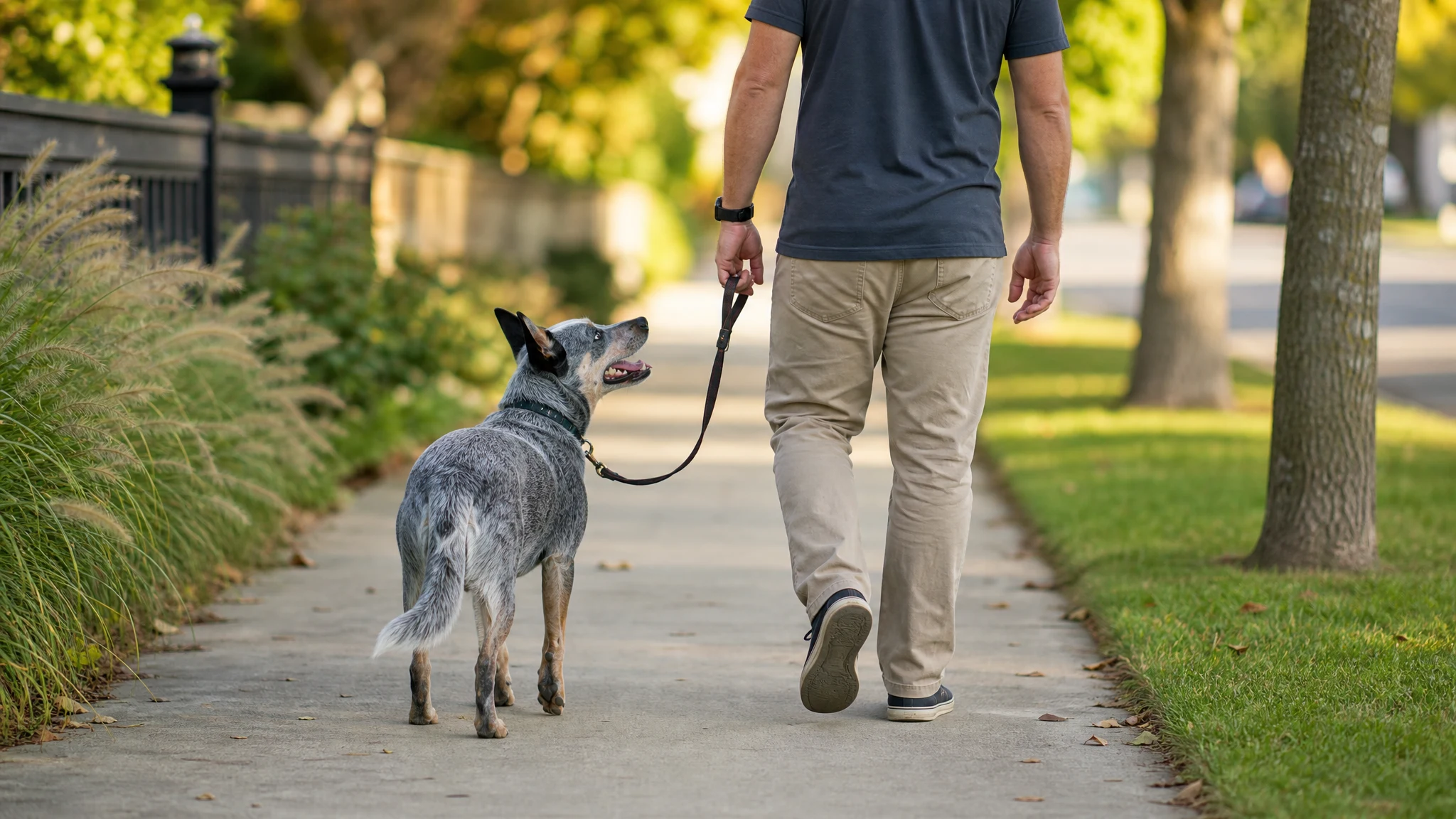
General training information. Every dog is an individual; for health or behavior concerns, see your veterinarian.
If your Blue Heeler hits the end of the leash like a sled dog, you are not alone. Blue Heeler leash training is one of the first things owners ask about, and one of the places this breed tests your patience most.
The good news is that pulling is a habit, and habits can be changed with clear, kind practice. This guide covers why the breed pulls, what gear to use, a step-by-step plan for loose-leash walking, and what to do when your dog lunges at something.
Why a Blue Heeler Pulls on the Leash
The breed's official name is Australian Cattle Dog. Blue Heeler is the common name for the blue-coated dogs. According to the Australian Cattle Dog Club of America (ACDCA), the breed was developed in 1800s Australia to work and move cattle on unfenced, harsh scrub range with large herds.
That history explains a lot. A dog bred to cover ground and keep stock moving does not naturally think a slow stroll is the point of a walk. The Westminster Kennel Club rates the breed 5 out of 5 for energy. That is a Westminster rating, not an AKC one, and individual dogs vary.
The ACDCA describes the breed as highly intelligent and self-directed, with a strong desire to please. The UK charity PDSA also lists independent thinking and determination among the breed's challenges. A smart, determined dog that has learned "pulling gets me where I want to go" will keep doing it.
Blue Heeler pulling on leash usually comes down to three things:
- Drive and energy. A dog that has not had enough exercise treats the walk as its only outlet.
- Reward history. Every time tension on the leash moves you forward, pulling is rewarded.
- Herding instinct. PDSA notes the breed may nip at heels, and movement such as joggers, bikes or running children can be exciting.
Materials You Need
Keep the kit simple and humane.
- A flat collar or a well-fitted front-clip harness. A front clip sits at the chest, so pulling turns the dog sideways instead of driving it forward. Either tool is a way to attach the leash, not a fix on its own.
- A standard 4 to 6 foot leash. Avoid retractable leashes for training. They teach a dog that pulling extends its range.
- Small, soft treats. Pea-sized pieces your dog finds exciting. Use part of the daily food ration if weight is a concern.
- A treat pouch. It keeps rewards fast and in the same spot.
- A clicker or a marker word like "yes." The ACDCA says the breed excels at clicker training.
What to leave in the drawer: prong collars, choke collars and shock collars. They work by causing discomfort, and the ACDCA notes that harsh physical methods are seen as a challenge by this breed. Reward-based training is also the approach supported by the American Veterinary Society of Animal Behavior (AVSAB).
Before You Start: Meet the Exercise Need
Training a tired dog goes better than training a wound-up one. PDSA says this breed needs over two hours of exercise a day, and the ACDCA says these dogs need a job or purpose, with both physical and mental exercise.
Before a training walk, give your dog a short game of fetch or a few minutes of trick practice. Take the edge off first, then work on manners.
For puppies, the ACDCA advises against extreme exercise until growth stops and the joints mature. Keep puppy sessions short and varied, and ask your veterinarian what is right for your dog's age.
How to Leash Train a Blue Heeler: Step by Step
These steps work for puppies and adults. Start indoors or in a quiet yard, and move to busier places only when your dog succeeds. If you are new to the breed overall, the complete guide to Blue Heeler training covers the foundations that make leash work easier.
Step 1: Get comfortable with the gear
Let your dog sniff the collar or harness, then feed a treat as you put it on. Repeat for a few days. Clip the leash on and let your dog drag it around the house under supervision, with treats for calm behavior. You want the gear to predict good things.
Step 2: Teach "check in" without the leash
Stand in a quiet room. Each time your dog looks at you, mark with the click or "yes" and give a treat. Soon your dog will offer eye contact on purpose. This one skill is what you will lean on later when a distraction appears.
Step 3: Reward position
Pick a side, left or right, and stick with it. Hold treats at your hip. Whenever your dog is beside you, mark and feed at your leg. Take a few steps, then reward again. Be generous at first, since a smart dog needs to learn exactly what earns the treat.
Step 4: Add steps and keep the leash loose
Walk slowly. Reward every few steps while the leash makes a "J" shape. Gradually stretch the distance between treats. Keep your own hands still and relaxed rather than gripping.
Step 5: Stop when the leash goes tight
The moment the leash tightens, stop moving. Stand like a tree and say nothing. When your dog turns back or the leash slackens, mark and reward, then walk on. The lesson is simple: tight leash means the walk pauses, loose leash means it continues.
Do not yank or jerk. Pulling back on the leash often makes dogs pull harder, and it can hurt the neck.
Step 6: Change direction
If your dog drifts ahead, say "this way" cheerfully and turn the other way. Reward when your dog catches up. A dog bred to think for itself often enjoys this, because it has to keep watching you to know where the walk is going.
Step 7: Move into the real world
Practice on a sidewalk, then near mild distractions, then somewhere busier. Each new place is a bit like starting over, so go back to frequent rewards. Keep sessions short and end while your dog is still doing well.
Loose-Leash Games That Fit This Breed
Games give a working breed something to do with its brain while it walks. Try these:
- Treat scatter. Toss a few treats on the ground and let your dog sniff them out, then call it back to your side. Sniffing is calming and is real mental work.
- Follow the leader. Walk in zigzags, circles and figure eights. Reward your dog for keeping pace with you.
- Stop and sit. Randomly stop. If your dog sits or stays beside you, reward. This builds attention without extra commands.
- Speed up, slow down. Vary your pace and reward your dog for matching it. It keeps a clever dog tuned in to you.
- Permission to pull. After a stretch of loose-leash walking, release your dog with a cue like "go sniff" toward something interesting. Using the interesting thing as the reward is powerful.
What to Do About Lunging
Lunging is different from ordinary pulling. A dog may lunge at other dogs, bikes, cars, joggers or strangers. The reason matters, and it is not always obvious from the outside.
The ACDCA says the breed is naturally suspicious of strangers per the standard, and PDSA flags herding behavior as a challenge. Westminster rates the breed 3 out of 5 for getting along with other dogs. Some lunging may come from herding excitement. Some may come from wariness. Some is frustration at being held back. Individual dogs differ.
A reward-based plan for triggers
- Find your dog's threshold. This is the distance at which your dog notices a trigger but can still take a treat and think. Stay beyond it.
- Mark and reward the look. When your dog sees the trigger and stays calm, mark and feed. You are teaching that the trigger predicts good things.
- Add distance before you add difficulty. If your dog tenses, stares or stops taking food, you are too close. Calmly turn and move away.
- Use a U-turn. If a trigger appears suddenly, say "this way," turn around and walk off, rewarding as your dog follows. No scolding.
- Close the gap slowly over many sessions. Progress is measured in a few feet at a time, not in a single walk.
For herding-style reactions to moving things, give your dog a better job. Ask for a sit and look at you while a bike or runner passes, then reward. The ACDCA and Westminster both point to herding, obedience and agility as natural outlets for the breed, which can also help channel that drive.
If lunging is intense, comes with growling or snapping, or seems to appear suddenly, talk to your veterinarian first. Pain and health problems can change behavior. A qualified trainer who uses reward-based methods can then help with a plan. Check how any trainer works before you hire them, and avoid anyone who uses force or intimidation.
Common Mistakes to Avoid
- Letting pulling work sometimes. Even a few steps forward on a tight leash teaches your dog that tension pays off.
- Skipping the exercise. Leash manners are hard for a dog with energy to burn.
- Going to hard places too soon. A busy park on day one sets your dog up to fail.
- Using corrections. Collar jerks, prong collars and shock collars add stress and can make reactivity worse. They also do not teach your dog what to do instead.
- Punishing growls or lunges. A dog that is told off for warning signs may stop giving warnings.
- Long, boring sessions. Smart dogs get bored. Keep it short, lively and varied.
- Ignoring heel nipping. PDSA notes puppies must learn not to nip inappropriately. Redirect to a toy or a treat, and reward calm walking. The ACDCA also advises teaching bite inhibition early.
Tips for Better Walks
- Use high-value treats around distractions, and lower-value ones at home.
- Practice short sessions several times a day instead of one long one.
- Be consistent. Everyone who walks the dog should use the same rules and the same equipment.
- Take a puppy class. The ACDCA recommends them, and they give controlled social practice.
- Pay attention to your own body. Tense shoulders and a tight grip on the leash can tell your dog to brace.
What Results to Expect
Most owners see small changes within the first couple of weeks of consistent practice, such as more check-ins and slightly shorter stretches of pulling. Reliable loose-leash walking in distracting places usually takes longer, and it may take months of regular work. Results depend on your dog's age, history, temperament and how often you practice.
Lunging at triggers often takes more time and may need professional support. Expect ups and downs. A bad day does not erase progress. If you are not seeing change after several weeks, a reward-based trainer can watch you and your dog in person and adjust the plan.