How Much Exercise Does a Blue Heeler Need? Plus Brain Games
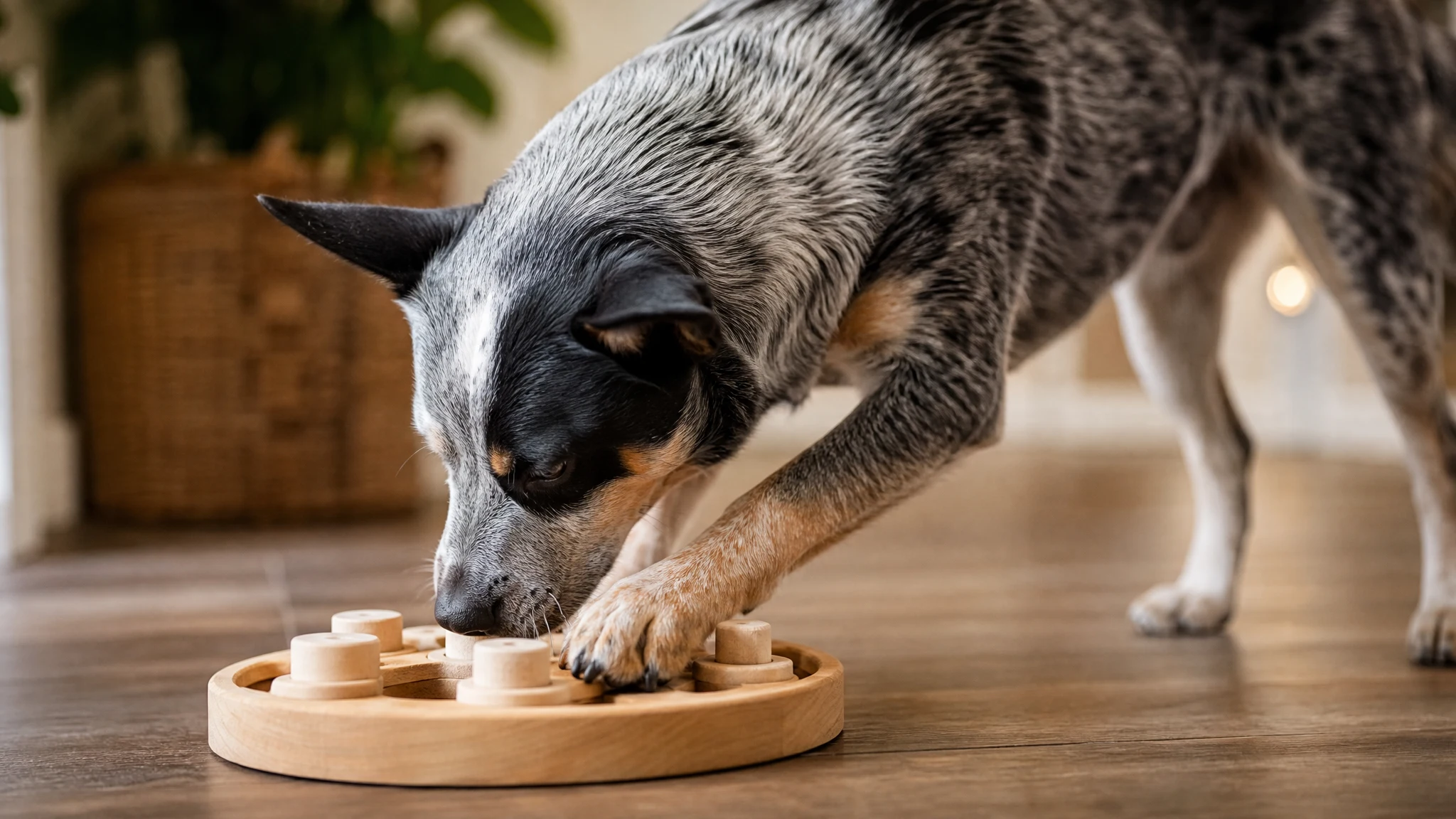
General training information. Every dog is an individual; for health or behavior concerns, see your veterinarian.
If you are asking how much exercise a Blue Heeler needs, the short answer is: a lot, and not only with the legs. This breed was built to work, and a dog with no job tends to invent one. Usually that job is your ankles, your couch cushions or your neighbor's mail carrier.
This guide walks you through a daily routine in steps. It covers physical exercise by life stage, then adds mental stimulation that fits what the breed was originally bred to do. If you want the bigger picture on manners and obedience, our complete guide to Blue Heeler training pairs well with this one.
First, what you are working with
The official AKC name is Australian Cattle Dog. Blue Heeler is the common name used for the blue-coated dogs. The Australian Cattle Dog Club of America (ACDCA), the breed's parent club, says the breed was developed in Australia in the 1800s to work large herds of cattle on unfenced, harsh scrub range.
That history explains the engine. The Westminster Kennel Club breed page rates the breed 5 out of 5 for energy level. Note that this is a Westminster rating, not an AKC one, and individual dogs vary. The ACDCA says these dogs need a job or purpose, and that they need both physical and mental exercise.
In plain words: a walk around the block will not cut it for most of these dogs.
What you need before you start
You do not need fancy gear. Most of this can come from your kitchen and yard.
- A well-fitted flat collar or harness and a sturdy leash (a 15 to 30 foot long line is handy for sniff walks)
- Small, soft treats your dog loves, cut pea-sized
- A food puzzle or a homemade one, such as a muffin tin with tennis balls over treats, or a rolled-up towel with kibble inside
- A clicker, if you want to try clicker training (the ACDCA says the breed excels at it)
- A few cardboard boxes, old towels and an empty yard corner or living room floor
- A ball or flirt-pole style toy for safe, structured play
- Water and a way to carry it on longer outings
Step 1: Set the daily exercise target for your dog's age
The UK charity PDSA says the breed needs over 2 hours of exercise a day. That is a useful ceiling to think about for a healthy adult, but it is not a number to hit on day one with a new or out-of-shape dog. Build up gradually.
Puppies
The ACDCA advises against pushing extreme exercise until growth stops and the joints are mature. That means no long forced runs, no repetitive ball chasing on hard ground and no hard jumping drills for a growing puppy.
The sources do not give a minutes-per-month formula, so do not rely on one you saw online. Ask your veterinarian what level of activity suits your puppy's age and build. In the meantime, lean on short play sessions, gentle sniffing and training games, which tire a young brain without pounding young joints.
Healthy adults
For a fit adult, think in terms of the PDSA's figure of over 2 hours a day, split into several blocks. That time includes walks, off-leash play in a safe fenced area, sport practice and active training. It does not have to be one marathon.
Remember that the ACDCA stresses mental exercise alongside the physical kind. A 20-minute brain game can take the edge off a dog that has already had a long walk.
Seniors
The sources I rely on do not give senior-specific exercise numbers. The ACDCA lists a typical lifespan of about 12 to 16 years, while the PDSA says over 10 years. As your dog slows down, ask your veterinarian how to adjust the routine, and keep the brain games going. They often stay enjoyable when long runs do not.
Step 2: Build a simple daily schedule
Splitting the day makes it easier to meet the total and keeps your dog from saving all its energy for 9 p.m. Here is a sample for a healthy adult. Adjust it to your dog and your vet's advice.
| Time of day | Activity | Type |
|---|---|---|
| Morning | Brisk walk or jog, then a short training session | Physical plus mental |
| Midday | Puzzle feeder or scatter-fed meal | Mental |
| Afternoon | Sniff walk or fenced-yard play | Both |
| Evening | Training game or herding-style play, then calm settle time | Mental, then rest |
Always end the day with a calm period, such as a chew or a mat settle. A working breed needs to practice switching off as much as switching on.
Step 3: Add sniff walks
A sniff walk is a walk where the nose sets the pace. It is one of the easiest ways to add blue heeler mental stimulation to something you already do.
- Pick a quiet route. Grassy edges, trails and parks where dogs are allowed all work. Check local rules on leashes first.
- Clip on a long line or use a regular leash with slack. Give your dog room to investigate.
- Say a release cue such as "go sniff" and let your dog follow scents for a few minutes.
- Pause with your dog. Do not tug it away from every smell. Reward check-ins with a treat.
- Alternate. Do a few minutes of brisk walking, then a few minutes of sniffing.
Many owners find that a 30-minute sniff walk leaves a dog calmer than a faster walk of the same length, though results vary from dog to dog.
Step 4: Use puzzle feeders and food games
Meals are free brain time. Instead of a bowl, make your dog earn some of its food.
- Start easy. Put a handful of kibble in a towel and roll it loosely. Let your dog unroll it.
- Try a muffin tin. Put kibble in a few cups and cover each with a tennis ball.
- Scatter feed. Toss a portion of the meal across the grass or a clean floor and let your dog hunt for it.
- Raise the difficulty slowly. Once your dog solves a puzzle in under a minute, add a step.
- Count it in the daily ration. Treats and puzzle food are part of the day's food, so adjust meals to avoid weight gain. Ask your vet about portions.
Supervise at first and take away any puzzle that gets chewed apart.
Step 5: Play training games that match the breed's original job
Cattle dogs moved herds across big, rough country. They had to think for themselves, work at a distance and respond to cues. The ACDCA describes the breed as highly intelligent and self-directed, and says positive training works best. It also notes that harsh physical methods are seen by the dog as a challenge. Keep everything reward-based, in line with the American Veterinary Society of Animal Behavior (AVSAB) position on humane training.
Game 1: Targeting and touch
Hold your hand out flat. When your dog touches it with its nose, click or say "yes" and give a treat. Then move your hand farther away, higher or lower. This builds the start-and-stop control that herding work needs.
Game 2: Go-to-mat
Reward your dog for stepping on a mat, then for lying down on it. Over several sessions, send it to the mat from across the room. This gives an energetic dog a clear "off switch" job.
Game 3: Find it
Ask your dog to wait, hide a few treats around the room or yard, then release it with "find it." Make the hides harder over time.
Game 4: Fetch with rules
Throw a ball, ask for a drop, then a sit before the next throw. The rules turn a pure adrenaline game into a thinking game. Skip this for puppies with growing joints if your vet advises it.
Game 5: Herding-style play and sports
The ACDCA's Versatility Award recognizes obedience, rally and agility, and AKC offers herding tests and trials. Westminster lists herding, obedience and agility for the breed. Check with a local club or the AKC for classes and events in your area. Do not assume one exists nearby until you confirm.
If you try herding instruction, choose an instructor who uses positive methods and ask to watch a class first.
Step 6: Watch the nipping and the mood
The PDSA notes that the herding instinct can lead to heel nipping, including at running children. The ACDCA says puppies must learn bite inhibition and not to nip inappropriately. Westminster rates the breed 3 out of 5 for good with children and 3 out of 5 for other dogs.
If your dog starts nipping at heels during play, calmly stop the game, step out of reach and redirect to a toy or a trained behavior. Reward the calm choice. Never punish with force.
Common mistakes to avoid
- Only adding more running. Extra miles can build stamina without solving boredom. A fitter dog still needs mental work.
- Overdoing it with a puppy. The ACDCA says to avoid extreme exercise until joints mature.
- Leaving the dog alone in the yard. The PDSA says the breed dislikes being left unattended in the yard. A yard is not a substitute for activity with you.
- Using harsh corrections. The parent club says positive training works best. Shock, prong and choke tools and dominance tactics are not part of this approach.
- Skipping early socialization. The ACDCA recommends socializing early and attending puppy classes. The breed is described as naturally suspicious of strangers, so start gently.
- Making every day exciting. Add rest and settle practice so your dog learns to relax.
- Ignoring pain or limping. Health concerns such as hip and elbow dysplasia are reported in the breed, per the ACDCA 2007 health survey and the PDSA. If your dog limps or seems sore, call your veterinarian.
Quick tips
- Keep sessions short and end while your dog is still keen.
- Rotate puzzles and games so they stay fresh.
- Use part of your dog's daily food as training rewards.
- Keep water available, and avoid hard exercise in hot weather.
- Ask your veterinarian about conditioning, especially for puppies and older dogs.
What results to expect
With a steady routine, many owners notice their Blue Heeler seems calmer in the house, settles more easily and chews fewer things it should not. Nipping and pacing may ease as the dog gets more outlets for its drive. Training games may also strengthen your bond and your dog's focus.
Results depend on the dog's age, health, past experience and temperament, and no routine works for every dog. Give any new schedule several weeks before judging it. If behavior problems continue, a qualified, reward-based trainer or your veterinarian can help rule out other causes.
A note on health checks
Exercise plans work best when you know your dog is healthy. The ACDCA's CHIC program lists hip dysplasia, elbow dysplasia, eye exams, prcd-PRA and primary lens luxation DNA tests, and deafness evaluation as required screening for breeding dogs. If you are buying a puppy, ask the breeder about these results. For any health question about your own dog, your veterinarian is the one to ask.